
Last updated November 4, 2026
 Wrought iron
 Wood & steel frame
 Farm & ranch
 Sliding driveway gates
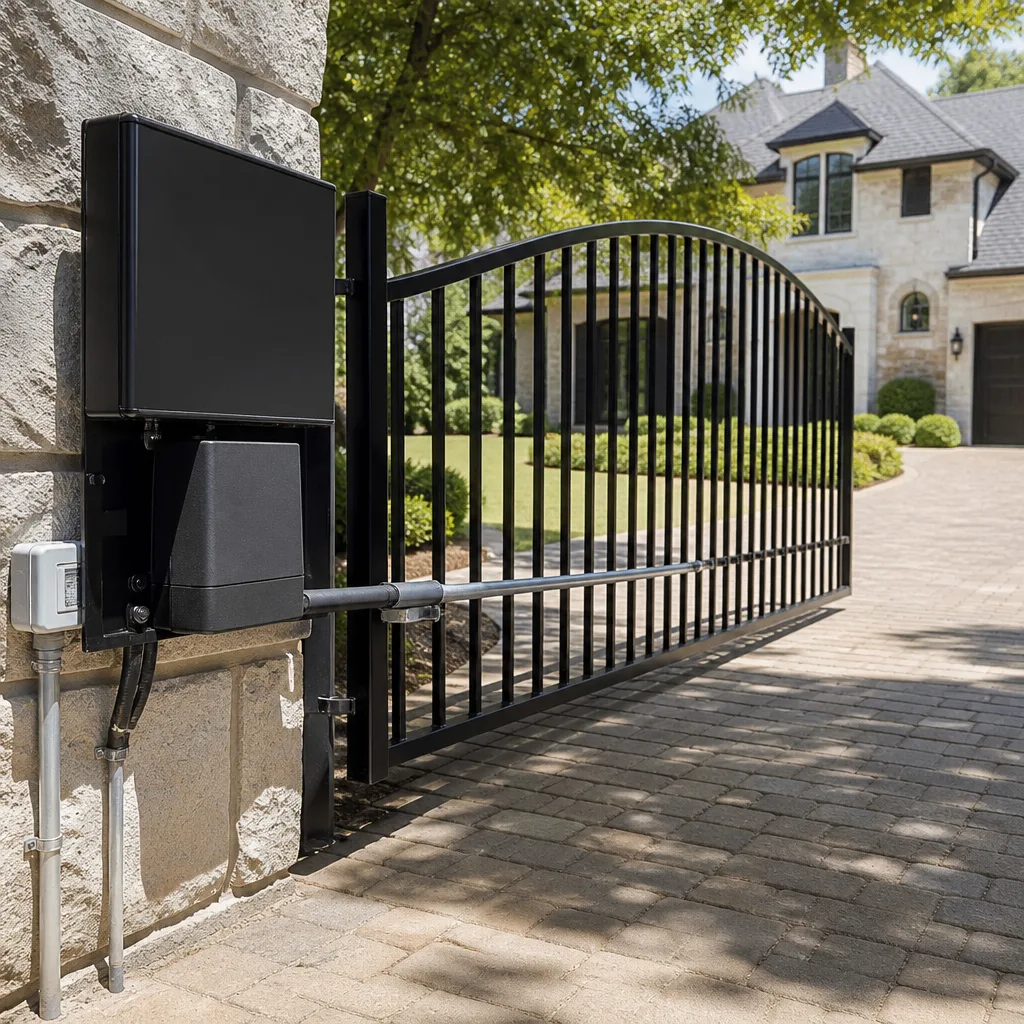 LiftMaster operators
Free on-site gate assessment - hinges, posts, and your LiftMaster or Nice gate operator checked before anything is quoted
The assessment is free and the quote is the invoice.
Get your free estimateGate Repair Emergency Preparedness Guide for Perris Homes
An automated gate in Perris is a working machine with a motor, a control board, limit switches, and moving steel. When it fails, the failure usually happens without warning, often at the worst possible moment. A gate stuck closed traps a car in or out. A gate stuck open removes the only real barrier between your property and the street. The problem is that most homeowners discover they have no plan the exact moment the gate stops responding. This guide gives you that plan before you need it, with specific steps for every major gate type and the brands Perris homeowners actually own.
Quick Answer
The first step in any Perris gate emergency is to locate your operator’s manual release and disengage the motor so you can move the gate by hand. A gate stuck closed is a security problem you may be able to resolve tonight. A gate stuck open is a safety and liability problem that needs temporary securing and a call to a gate repair specialist. Knowing the difference changes everything about your next 30 minutes.
Styles & brands we work with
- Wrought iron
- Wood & steel frame
- Farm & ranch
- Sliding driveway gates
- LiftMaster operators
Table of Contents
- How to Use the Manual Release on Every Gate Type
- Gate Stuck Closed: Security Response
- Gate Stuck Open: Safety and Liability Response
- The First 30 Minutes: A Diagnostic Sequence
- Temporarily Securing an Open Gate in Perris
- What to Have Ready Before You Call
- Common Mistakes to Avoid
How to Use the Manual Release on Every Gate Type
Every automated gate in Perris has a manual release mechanism. It exists for exactly this situation: the motor fails, the power goes out, or the control board stops responding. The release disengages the operator from the gate leaf so you can push or slide the gate by hand. What surprises most people is that the release differs by operator type and by brand. A Viking operator releases differently than a Ghost Controls operator, and a sliding gate release is not the same as a swing gate release.
On most sliding gates, the release is a lever or pull chain mounted on the operator housing, usually near the motor. Pulling it disengages the drive gear from the rack. On swing gates, look for a keyed release cylinder on the operator arm itself, or a handle that lifts the arm off the gate bracket. Vertical lift gates are less common in Perris residential settings, but when they exist, the release is typically a pin that disconnects the lifting arm from the gate panel.
Here are the steps that work for most residential operators:
- Find the operator housing. It is the box with the motor, usually mounted on a post or a concrete pad near the gate.
- Look for a release lever, pull chain, or keyed cylinder. On Viking operators it is usually a mechanical lever on the side of the housing. On Ghost Controls residential swing operators, the release is typically a pull handle on the arm itself.
- If there is a keyed release, use the key that came with the gate. Keep that key somewhere you can find it in the dark, like a hook near the garage door or on your key ring.
- Disengage the operator and test the gate by hand. It should move freely, though a long slide gate will be heavy and take some effort.
- Once the gate is in the position you want, you can leave it disengaged until a technician arrives. Do not try to run the motor while the release is disengaged.
Brand-specific knowledge matters here. In our experience, DoorKing and Elite operators, which are more common on commercial properties and larger residential lots in the Perris area, often have a manual release that requires a key and a deliberate turn of the mechanism. Forcing it is a fast way to strip the release gear or bend the internal linkage. If you do not know where the release is on your operator, walk the perimeter of the housing now, in daylight, before you need it at night.
Gate Stuck Closed: Security Response
A gate that will not open keeps your car in and keeps everyone else out. That is the more contained failure. The property remains secured, which means you can take a breath and work through the problem without the pressure of an unprotected opening onto the street.
Your first move is the manual release described above. Disengage the motor and try to move the gate by hand. If it moves smoothly, the problem is in the operator, the control board, or the power supply. If it will not move at all, the problem is mechanical: a wheel off the track, a hinge that seized, a rack section that shifted, or a panel that is binding against a post.
For a sliding gate in Perris, check the track first. Desert dust and fine sediment build up in the track rollers and the guide wheels. If a roller has locked up, the gate will feel like it is glued down. Debris accumulation is a year-round issue here, not just after storms. If the gate is off its track even slightly, do not force it. The weight of a sliding gate panel can crush a hand or foot if it tips while you are pushing on it.
For a swing gate, look at the hinges and the operator arm. A bent hinge pin or a cracked weld on the gate frame will stop the leaf from swinging. If the operator arm is still attached but the gate will not move, disconnect the arm completely and try the gate by hand. That separates an operator failure from a structural failure.
A stuck closed gate is a security emergency in the sense that you cannot get your vehicle out, but the property stays protected. The goal is to get the gate opening manually tonight and then call for repair on your schedule.
Gate Stuck Open: Safety and Liability Response
A gate that fails open is the harder problem. The property is now open to the street, which means anyone can walk or drive in. If you have a pool, dogs, small children, or stored equipment, an open gate is a liability, not just an inconvenience. In Perris, where many properties on the eastern side of the city are on larger lots with more distance from the street, an open gate can be less visible. On a tighter lot in the older neighborhoods near downtown, an open gate faces the sidewalk directly.
The sequence is different. First, manually push the gate closed if it will move. Disengage the operator and physically close the gate, then secure it in the closed position. Do not re-engage the operator expecting it to hold the gate. A failed operator will not hold anything.
If the gate will not move because of a mechanical failure, your job is temporary securing. Options depend on the gate type and property layout:
- Swing gate: Use a heavy-duty chain and padlock to bind the two leaves together at the center, or chain the free leaf to a fixed post. Do not use rope or bungee cords. A swing gate in the wind becomes a sail, and Perris gets strong afternoon winds through the San Jacinto Valley.
- Sliding gate: If the gate is off its track, it cannot be slid closed. Block the opening with a vehicle until a technician can arrive. If the gate is on its track but the motor failed, push it closed and set a wheel chock or a steel wedge against the leading wheel to prevent it from rolling back.
- No way to close the gate: Secure the property itself. Lock the front door, put cars in the garage if possible, bring anything valuable inside, and if you have animals, contain them. Tell anyone on the property the gate is down.
The safety note here is serious. A sliding gate panel weighs hundreds of pounds. If it is leaning, do not try to walk it back onto the track. One person cannot safely right a derailed gate panel, and the leading edge can drop without warning. This is a situation for a trained technician with lifting equipment.
The First 30 Minutes: A Diagnostic Sequence
When a gate fails, most people cycle the remote a dozen times, try the keypad, then call the first number they find. There is a better sequence. Working through it determines whether this is a tonight problem or a secure-the-property-and-schedule problem.
- Check the power. Is the operator plugged in and is the outlet live? In Perris, power outages during summer heat waves or Santa Ana wind events are the usual suspects. Check the breaker. Reset it once. If it trips again immediately, there is a short in the operator or the wiring, and continued resets are a fire risk.
- Test the controls. Try the keypad, the remote, and the intercom or phone app if you have one. If nothing works, the problem is likely power or the control board. If the keypad works but the remote does not, you have a transmitter or receiver issue, not a gate motor issue.
- Check the safety edges and photo eyes. An obstructed or misaligned photo eye will stop a closing gate in its tracks. On Ghost Controls and Mighty Mule residential systems, the photo eye is a common failure point. Look for broken wires, misalignment, or a lens covered in dust.
- Listen. When you press the remote, does the operator hum? A humming motor with no movement points to a seized gear, a jammed drive, or a capacitor problem. Silence points to the board or the power supply.
- Disengage the manual release and move the gate by hand. This is the single most important diagnostic step. It separates gate problems from operator problems instantly.
By the end of this sequence you know three things: whether the gate moves, whether the operator responds, and whether the safety systems are interfering. That information changes the whole repair call. Instead of “my gate does not work,” you can tell the technician exactly which systems are live and which are dead.
Temporarily Securing an Open Gate in Perris
Temporary securing is not a repair. It is a bridge between the moment the gate fails and the moment a technician makes the actual fix. The method depends on how your gate failed and what your property looks like.
For a swing gate that will not close because the operator arm is dead, you can remove the arm from the gate bracket and push the gate closed by hand. Most residential swing operators use a clevis pin at the gate bracket. Pull the pin, lift the arm off, and the gate swings free. Then secure it closed with a chain and padlock as described earlier. If you do not have a chain rated for the job, use a ratchet strap with a high working load limit. A cheap strap from the trunk will stretch and fail in a Perris wind event.
For a sliding gate that is on its track, push it closed and either chock the wheels or tie the leading post to the fence post. Do not rely on the dead operator to hold position. Without the drive gear engaged, the gate will creep on any slope. Many Perris driveways are graded toward the street for drainage, which means a released sliding gate will roll toward the road on its own.
If you cannot move the gate at all, the practical options are limited. Park a vehicle across the opening. Lock the house. Notify other residents or tenants. For a commercial property in the Perris area with a failed access gate, post a sign and, if possible, position a vehicle to block vehicle access after hours. The liability exposure for a business with an open gate and no barrier is real.
What to Have Ready Before You Call
The difference between a one-trip repair and a two-trip repair is the information you provide before the technician leaves the shop. Gate operators are not interchangeable. A Viking control board is not a DoorKing control board, and a Ghost Controls swing arm is not a Mighty Mule swing arm. The technician needs to know what they are walking into.
Before you call, gather the following:
- Brand and model of the operator. The brand name is on the operator housing or the control box. LiftMaster, FAAC, BFT, Linear, Viking, Ghost Controls, DoorKing, Elite, and Mighty Mule all use different parts. If you can read the model number off the unit, that is even better.
- Gate type. Sliding, swing, or vertical lift. Single leaf or double leaf. Steel, iron, or aluminum.
- What you have already tested. Power status, breaker condition, remote and keypad function, manual release result. This saves the technician a diagnostic step and speeds the repair.
- When the problem started. Did it fail suddenly during operation, or has it been intermittent for a week? An intermittent problem that got worse is usually a different failure than a sudden dead gate.
- Whether the gate is stuck open or closed. This sounds obvious, but it changes what the technician brings. A gate stuck open may need lifting equipment to reset a derailed panel. A gate stuck closed is often a control or motor issue that can be fixed on the spot.
- Forcing the gate when it is off the track. A derailed sliding gate panel weighs too much to muscle back into place. Forcing it bends the track, breaks wheels, and risks a crush injury. This is the most expensive mistake Perris homeowners make.
- Cycling the remote repeatedly while the breaker is tripped. Each reset attempt on a tripped breaker sends another surge through a damaged component. If the breaker trips twice, stop resetting it.
- Using the manual release without knowing where it is. Searching for the release in the dark with a phone flashlight wastes time and leads to yanking on the wrong part. Find it today, in daylight.
- Leaving the gate disengaged after a temporary fix. A released sliding gate on a sloped Perris driveway will roll toward the street. If you disengage the operator, secure the gate in place.
- Calling without the brand name. “My gate does not work” tells the technician nothing. Brand and model dictate parts. Know what you own.
- Assuming the gate is broken when the remote battery is dead. The keypad and the remote are separate systems. If the keypad works and the remote does not, the battery in the remote is your first check.
- Leaving an open gate unblocked overnight. An open gate on a Perris property with no barrier invites problems. Even a vehicle parked across the opening is better than nothing.
We work on the brand you already own. When you call with the brand and model ready, our technicians can verify parts availability before leaving the shop. That is the practical difference between a specialist who knows gate systems and a generalist who has to diagnose from scratch in your driveway.
If you need gate repair in the Perris area, call (866) 569-6762. We answer 24/7. Fast dispatch from 7am to 7pm, Sunday through Friday. The estimate is free, and the written price is set before any work starts.
Common Mistakes to Avoid
See the difference
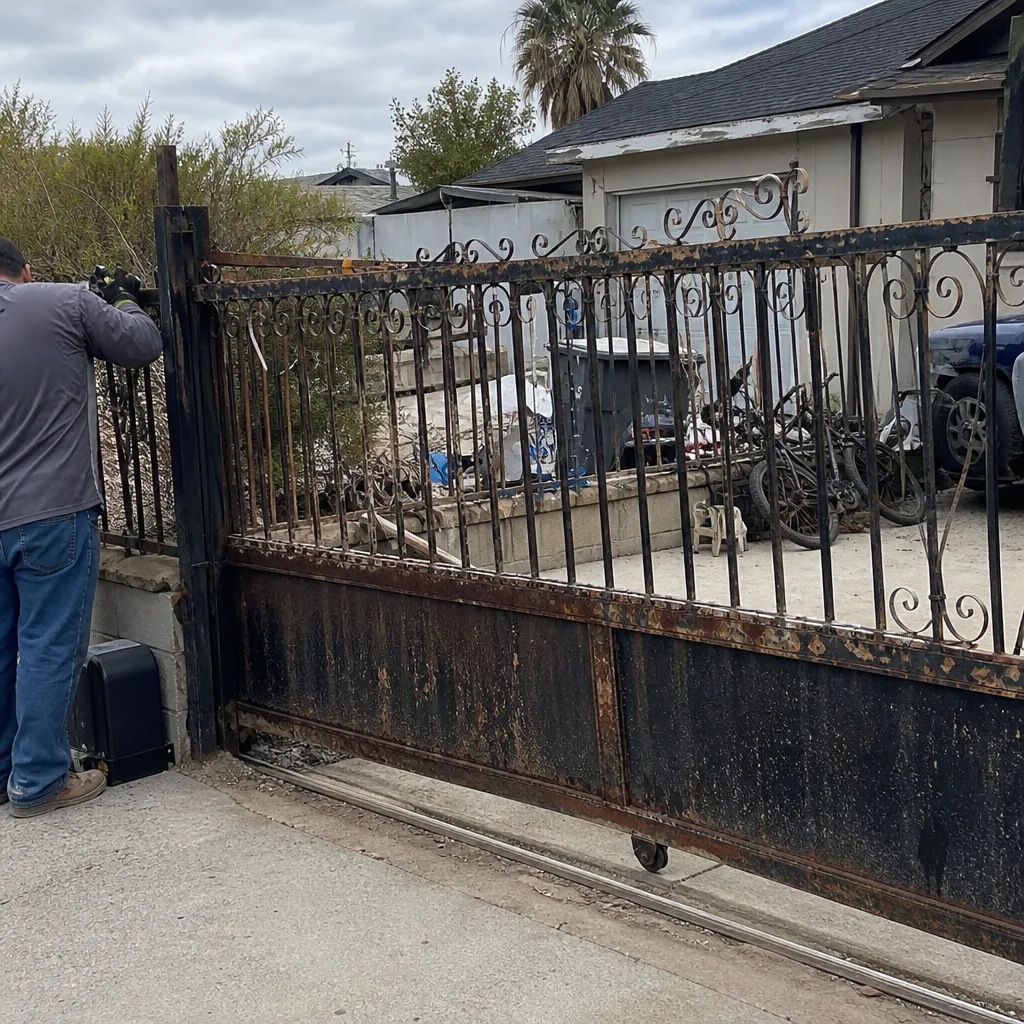 Before
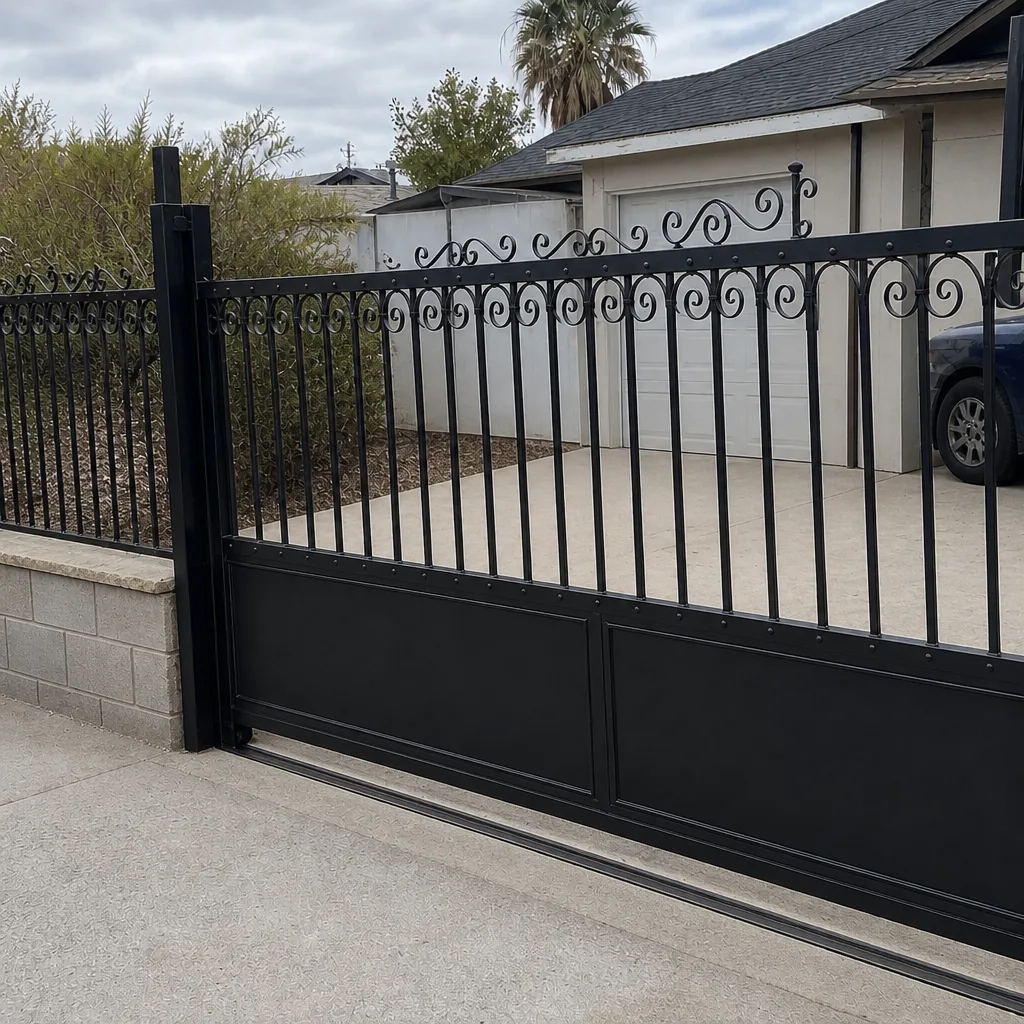 After
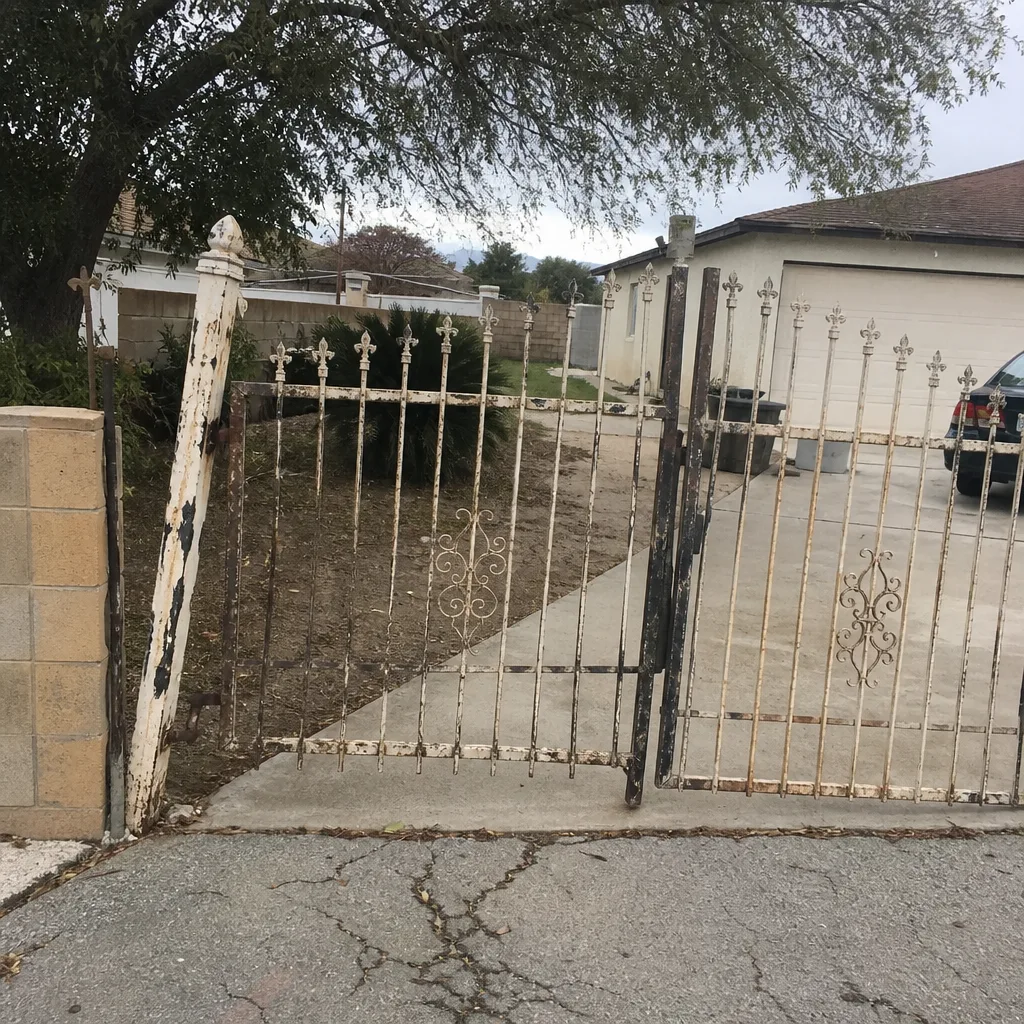 Before
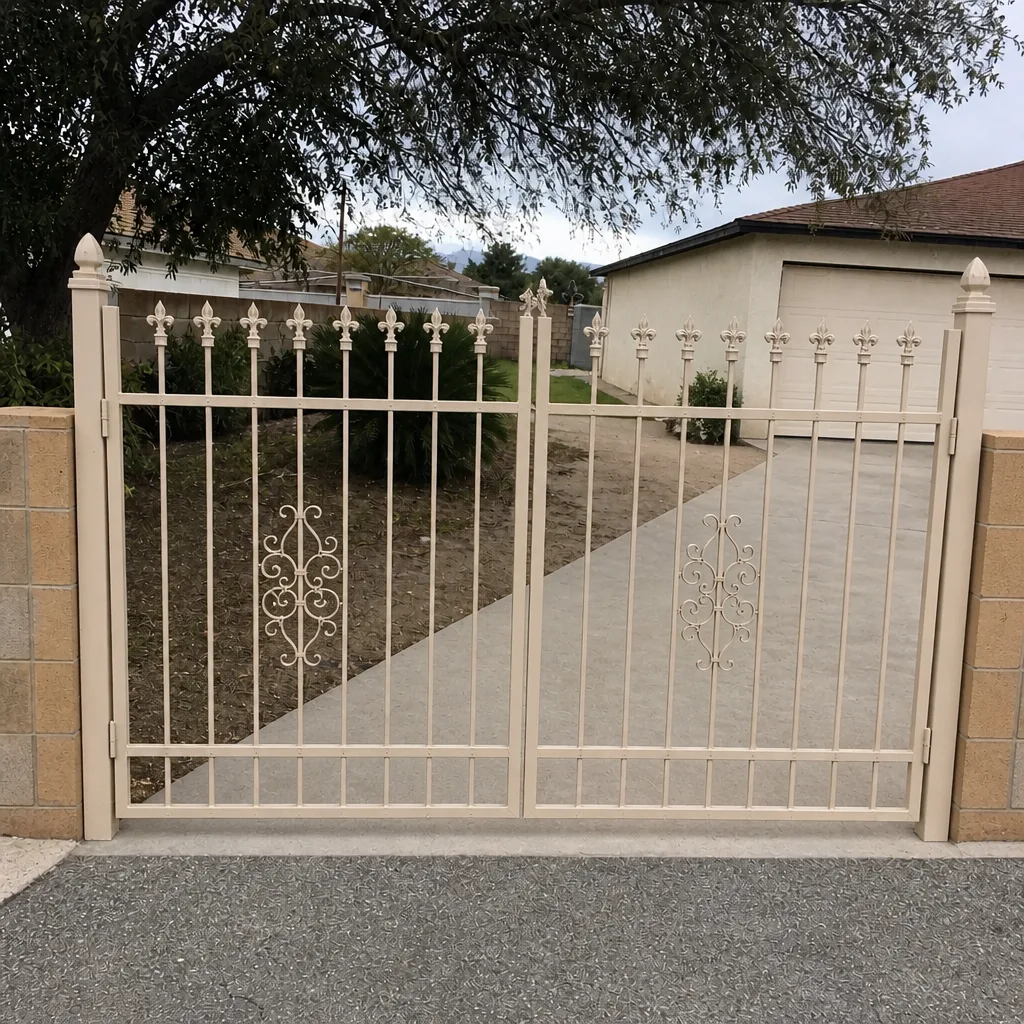 After
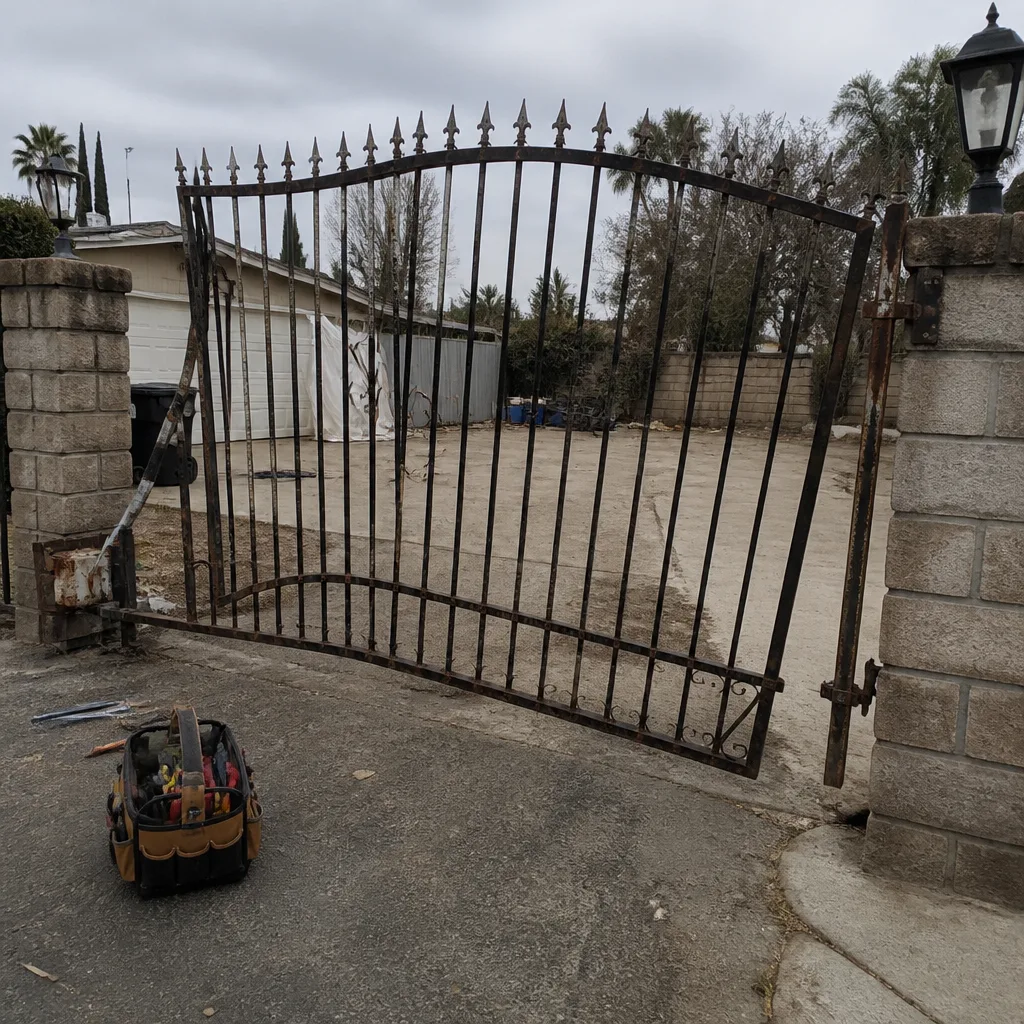 Before
 After
When to Call a Professional
Some gate failures resolve with a manual release and a fresh remote battery. Most do not. Call a professional when the operator makes no sound, when the breaker trips repeatedly, when the gate is off its track, when the control board shows visible damage, or when the gate moved fine by hand but the motor will not engage. These are not diagnostics you should attempt with a multimeter and a YouTube video. The wiring in an automated gate operator carries line voltage, and a slide gate that is off its track is a crush hazard.
Electric or manual, we diagnose by system. Gate Repair Perris offers free estimates in Perris. Call (866) 569-6762. We answer 24/7. Fast dispatch from 7am to 7pm, Sunday through Friday.
Frequently Asked Questions
Check the power supply and breaker, then use the manual release to disengage the operator and try moving the gate by hand. This tells you immediately whether the problem is the operator or the gate itself. Call (866) 569-6762 for electric gate repair in Perris. We answer 24/7.
Same-day service is available. Call (866) 569-6762, and we will book you into the soonest dispatch window from 7am to 7pm, Sunday through Friday. Having the brand and model ready helps our technician arrive with the right parts.
Yes. A gate stuck open removes the physical security barrier from your property, which is a liability if you have children, pets, or accessible equipment. Secure the gate manually if you can. If not, block the opening and call (866) 569-6762 for Perris gate repair. We answer 24/7.
We service gate operators from Viking, Ghost Controls, DoorKing, Elite, LiftMaster, FAAC, BFT, Linear, and Mighty Mule, for both residential and commercial systems. We diagnose by brand, not by guesswork.
Every gate repair is priced per job after a free on-site estimate, and the written price is agreed before any work starts. The cost depends on the failure, the brand, and whether parts are needed. Call (866) 569-6762 for a free estimate.
Yes. A sliding gate panel off its track is heavy, unstable, and can drop or tip without warning. Do not try to lift it back onto the track yourself, and keep children and pets away. This is a job for a trained technician with the right equipment.
The Bottom Line
An automated gate in Perris is only as reliable as its weakest component: a motor, a board, a limit switch, a roller, a hinge. When it fails, everything comes down to preparation. Know where your manual release is, know whether your gate is a slider or a swinger, and know which brand is bolted to your post. A gate stuck closed is manageable. A gate stuck open is a liability. Either way, the fix starts with a diagnostic sequence you can run yourself in the first ten minutes, and the right call after that. Keep the number saved. The next failure is not a matter of if.
Written by the team at Gate Repair Perris, serving Perris since 2012.